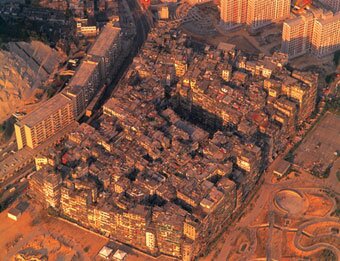
In the context of the Twentieth century, the Kowloon Walled City was totally unique. Situated within Hong Kong?s sprawling suburbs, the city within a city was to a great extent, economically, legally and physically exempt from the outside world. Until its The origins of the Kowloon Walled City go back as demolition, which was completed in 1993 it represented a rare entity -? a truly self-regulating, self-sufficient, self-determining modern settlement.
far as 1841, when Britain occupied Hong Kong Island. This presented the Chinese with a serious problem ? how could they defend Kowloon from a possible British invasion? Their solution was to set up a small garrison in Kowloon City, which was quickly followed by barracks and training facilities. The Viceroy of Canton, who oversaw the construction of the fort was still concerned at Kowloon's vulnerability and felt a visible and psychological symbol of control was needed to discourage the barbarians in Hong Kong As a result the Viceroy ordered the building of a wall around the fort. It is out of these confrontational foundations that the Kowloon Walled City began to grow. By 1947 it had become a defended settlement of six and a half acres, numbering 150 men.
In 1860, the Kowloon peninsula and Stonecutters Island came under British sovereignty ? the colonists were clearly eager to gain control of the mainland facing the Island as a military buffer zone. The garrison just to the north became an increasingly important as an outpost for observing the British, and the forts population grew as a result. The border between Kowloon and China was not closed; and the Kowloon Walled City, as it was now named developed into a popular stop off point for locals, foreigners and British soldiers. Some sought antiquaries; most sought opium or whores ? which along with gambling would become the walled city?s most prominent sources of business.
The walled city garrison continued to grow. By the 1890s it had around 500 soldiers, their dependants and a growing civilian population maintaining the various businesses and amenities that surrounded them. As the civilian population within the city?s walls grew, the relevance of the military administration decreased. The colonial administration turned a blind eye to the odd soldier and trader nipping in for a bit of this or that. The Chinese ignored whatever entrepreneurial activities the residents had developed. Above the board enterprises could be taxed. Undertakings of a circumspect nature were always liable
to back-handers.
At the Convention of Peking on the 9th June 1898 Britain obtained the New Territories under a ninety-nine-year lease. There was one exception, Chinese officials could remain in the Walled City, as long as it was not inconsistent with the military requirements of the defence of Hong Kong This was of no consequence to the British ? until the following year when local peasants rebelled, and attacked colonial traders in the new region. The then Governor of Hong Kong, Sir Henry Blake, asked the Viceroy of Canton for protection and requested the Chinese customs post in the Kowloon Walled City be closed down. The viceroy sent in 600 troops, half of which, unbeknown to Blake, moved into the Walled City. Deadlines for their removal were not met. Their presence was deemed inconsistent to the military requirements of the defence of Hong Kong and British troops were sent in to remove them.
This military intervention would set the stage for eighty years of political argument, and claims and counterclaims over actual jurisdiction. In the meantime the population of the Walled City continued to grow, all but ungoverned and outlawed becoming, in effect, the tiniest city-state in the world. Theoretically controlled by the British, technically owned by China, and actually governed by whoever wielded power within such an anarchistic enclave ? invariably gangsters.
Throughout the rest of the City?s history various confrontations have taken place. The Japanese, who occupied Hong Kong from 1942-45, must have feared whatever lay within the Walled City?s murky interior, and attempted to dismantle it. They achieved little, except pulling down the old exterior garrison wall. In 1947 the British tried to demolish the now wall-less walled City and build a park. The Chinese rejected this, claiming it remained the official residence for their representative. In 1948 the British did evict 2,000 squatters from the surrounding area and demolished their huts ? the rioting that followed ensured they didn?t try any more colonial re-development in the area.
1966 saw the Cultural Revolution in China and the communist flag was briefly raised in the city. Official attempts to remove it were met with more rioting. British policy came to regard Walled City as something of a hornets nest ? best not to be kicked unless absolutely necessary. In the meantime the Kowloon Walled City continued to develop and regenerate within itself. Buildings twelve stories high, sprouted up, without any adherence to planning law. Businesses blossomed ? without the slightest concessions to legislation or taxation. Every nook and cranny within its tiny acreage was expanded out, and crammed into, until its intricate labyrinth of thoroughfares and pathways received not a ray of sunlight, even at high noon. The health authorities kept away. So the City just developed its own legion of ad-hock clinics and dental surgeons. In the absence of telephone and utilities companies the City?s inhabitants just by-wired their own electricity and connections. The same nick-it-yourself approach applied to plumbing and water. As a result a tangled network of pipes and wiring dripped and hissed above the city?s dark, dank walkways. Cheap amenities for the residents, and, considering the extremely limited access, either in or out of the compound ? a potentially catastrophic fire-hazard.
For years the Kowloon Walled City became a no go area. In the control of Triads and drug dealers, with an estimated population in excess of 30,000. Many residents were illegal immigrants; exempt from extradition, encased within its walls. A lone European venturing into its midst would most probably never be seen again, no Chinese went in without appropriate reason. Only after Margaret Thatcher had signed away Hong Kong?s sovereignty did its future landlords, the communist Chinese have the ability to finally evacuate the Walled City?s stubborn population between 1988-92 and then destroy its derelict, decrepit, rat infested shell. It was only in these final years of gradual abandonment that a few journalists, photographers and investigators were able to wander unchallenged, around the Walled City?s uncharted labyrinths and give embellished accounts. Two of them were photographers: Greg Girard and Ian Lambot, who spent four years exploring the City. The vast collection of photographs they amassed during this time can be seen in their book City of Darkness: Life in Kowloon Walled City, which has recently been reprinted. All the photographs that accompany this article are taken from it.
|